Quick thoughts: post-U.S. elections 2025
Mamdani!!! And the future of the Democratic party
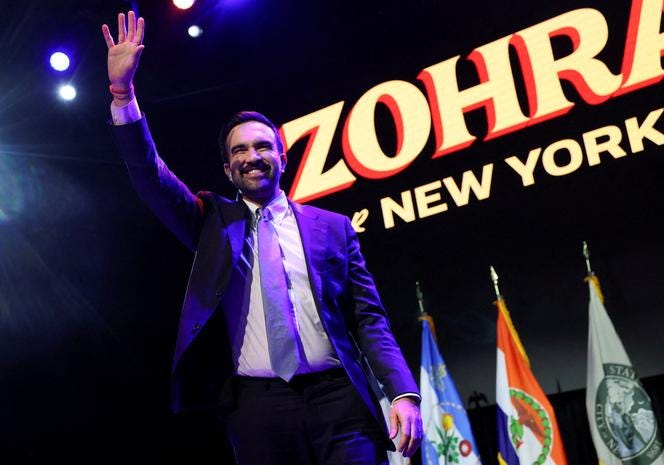
It’s hard being a progressive (or as I prefer to call myself, a liberationist) in the United States: we’ve had our hopes crushed too often.
So it was a relief to wake up this morning to the first elections of the Trump 2.0 era and see that finally we have elected a candidate we can be happy about: member of the Democratic Socialist Party Zohran Mamdani’s emphatic victory in the New York City Mayor’s race, over another neoliberal money-backed establishment old-guard Democrat candidate.
That enthusiasm was tempered by early results in the mayoral election here in Seattle, where I live, where the neoliberal money-backed candidate is up in early returns (though there’s still hope that Katie Wilson, the progressive candidate I’m supporting, will pull through in late ballot returns).
This to me is the stakes of this election: there is no hope for the political future of the United States as long as old-school money-backed establishment Democrats cling to power. Our only hope is for progressive liberationists to take over the party, just as MAGA and Trump took over the Republicans.
Some thoughts:
It’s the Belonging (in community, together!)
Regular readers will not be surprised that this is my primary takeaway. What Mamdani did best was bring people together around an inspiring message. He united over 100,000 (!!!) volunteers, en route to amassing over 1,000,000 votes… an astonishing feat for an off-year election. As Anand Giridharadas put it:
The profound insight of the Zohran Mamdani campaign was that people want to be summoned to do more, not less; they want to get together, not lurk on screens alone; they want to belong in hope, not just commiserate in anger; they want to organize, not agonize.
He did this with a bold vision, a relentlessly positive message (yes we can!), an inclusive politics (reaching out to Trump voters without pathologizing their choice, including/especially in communities of color), and by actually doing the street-level work of organizing.
He also represents the next Gen in his embodiment: unapologetically multi-racial/multi-ethnic, social media savvy, and on the right side of history on the major issues of the day (including staunchly opposing the Israeli-led genocide in Gaza).
Framing this as Democrats vs Republicans misses the point
There are two things we need to understand about the shape of party politics in the United States in November 2025.
First, we need to understand that the national Republican party as we have historically understood it no longer exists: Trump executed a complete takeover, and it is now the MAGA party… with some minority holdouts who occasionally offer tepid resistance. We do ourselves a cognitive disservice in referring to it as the Republican party: the party of Abraham Lincoln (and indeed, even Ronald Reagan) is long dead.
Instead we need to view the Republican party for what it is: an autocratic party committed to strongman rule, that is actively supporting fascist takeover. (It’s important to note: not every Republican member of Congress sees themselves as doing this: but in this case, impact matters more than intent). It is also true that in the states, counties, and municipalities outside of the DC Beltway there are still pockets of more traditional Republicanism (though at any level of national prominence they are a dying breed).
Second, we need to understand that the Democratic party is reviled by large swaths of the population… including most of its base. It’s no accident that the most popular figures in Democratic politics in the last decade… are NOT actually Democrats. Alexandria Ocasio-Cortez rose to power as a Democratic Socialist… in direct challenge to an old-school money-backed neoliberal Democrat. “The Squad” that got elected in 2018 largely did so by distancing themselves from the traditional Democratic party. Bernie Sanders is an Independent.
This is not a “blue wave”: this is an anti-Trump wave, led by liberationists with a vision that rejects the dead-ends of Trumpism and mainstream Democratic politics. The energy in the Democratic party… is not in the Democratic party. Rather, it’s among Leftist political pragmatists who understand that in a two-party system we need to leverage the Democratic party as a tool to claim power… and to reshape the party in our image.
Credit where it’s due: in NYC to the Working Families Party, the Democratic Socialists of America (DSA), and all those organizers and canvassers who door-knocked Mamdani to victory… AGAINST a mainstream establishment Democrat.
Abundance (progressive liberalism) vs Liberation (liberationism)
Yes this election is a profound rejection of Trump and what he stands for… thank the deities for that. But I don’t think 2024 was an endorsement of Trump and what he stands for: to me the clearer message was a rejection of the Democratic Party and what IT stands for. The plutocratic gerontocracy at the top of the party (Schumer, Biden et al) did not get the message in 2020, when we held our noses because we understood that the imperative was to get Trump out of power. Consequently, many voters understandably turned their backs: if you won’t stand up for us, why should we stand up for you? (To be clear: I still think defeating Trump was/is imperative, but I empathize with those who made different choices).
There will be those (read: New York Times) who will do their best to refuse to acknowledge the obvious to their rich readers, so let me be clear: the American people (and the base of the Democratic party) have repeatedly and profoundly rejected neoliberalism. Let it die. Our task: defeat establishment Democrats, and follow the Mamdani playbook.
Instead the debate worth paying attention to I think of as Abundance (after Ezra Klein’s new book) vs Liberation. I think there are actually two things going on here, and they get conflated: one is a theory of change about how you win power, and one is about the content/policy platform of what’s needed to respond to this moment. I’ll get to theory of change in a moment (they’re related, of course), but for now let’s focus on content.
In Abundance Klein offers a profoundly reformist agenda, arguing for how we can make government work better for people. I think of it as progressive liberalism: what we might call the Elizabeth Warren wing of the party. It accepts the boundaries/core tenets of liberalism (as both a political and economic ethos) and tries to implement the economic ethos. It sees the core problem as liberalism failing to deliver on its promises… and seeks to deliver through technocratic efficiency.
Mamdani, by contrast, campaigned on a Democratic Socialist agenda (what I think of as a more liberationist agenda). It’s a much bolder and more ambitious vision that agrees that liberalism has failed to deliver… and instead of trying to salvage it offers to replace it with a democratic socialist vision. It understands—correctly, in my view—that it is liberalism that is producing the crisis, and therefore cannot be the antidote.
In last night’s most important election, Mamdani’s vision won.
Of course the actual answer is to reject the false binary here and focus on what I call visionary strategy: delivering material gains inside the current reality, while orienting relentlessly toward a bold vision for the future. How we integrate this polarity (visionary future vs pragmatic present) is one of the central quandaries of the moment, and one most pundits continue to misunderstand.
Big tent vs rally the base: theories of change
Here’s another false binary, but one with profound implications for how we organize. In an important conversation with Ta-Nehisi Coates, Klein argued that we need a big tent/broad coalition to defend democracy in the United States. While the conversation was ultimately frustrating and degenerated into false binaries and straw men (I agreed with Anand Giridharadas’ take here), I think it speaks to an important debate in how we think about building power. The other traditional model (which Trump rode to power in taking over the Republican party) is to rally the base.
This debate also played out in a recent conversation between movement strategist Tynesha McHarris and Inside Philanthropy editor David Callahan. This too I found a frustrating exercise in false binaries and straw men: I see these discussions as about balancing (and integrating!) polarities rather than trying to persuasively “win” one side. David argued for a broader tent (expanding from what he sees as an overly narrow focus on “identity politics”); Tynesha argued for centering those most marginalized and building political coalitions around those intersectional interests.
The answer, of course, is to integrate the polarity: they’re both right. Tynesha is right that we do need to continue to center the needs of our base, and to reject the false binary that sees issues of class or economics (so-called “bread and butter” issues) as separate from issues of identity (race, gender, LGBT). And David is right that we do need to be thoughtful about our messaging and our audiences, and how an over-emphasis on identity can play into divide-and-conquer us/them politics.
I think Mamdani got it right: focusing relentlessly on issues that affect everyone (making affordability the centerpiece of his campaign) without shying away from an intersectional analysis that understands how some are disproportionately affected (e.g. offering a three-point plan protecting LGBT rights).
What do we do about rich people?
This is the thing I’m struggling with, especially here in Seattle (but also New York). I’m deeply disappointed in the wealthy voting narrowly to defend their economic interests, and their apparent willingness to throw the rest of the city under the bus. To me it follows logically that those who have the most privilege have an obligation to share that bounty with those who have less; I find it infuriating that those who have the most seek not only to cling to their (usually ill-gotten) gains, but also to deny others the same opportunities (Trump’s big tax break to the wealthy is funded by stealing from those with less wealth).
That said: our (left/progressive) current way of organizing with regard to the wealthy also bothers me. One of my biggest frustrations with current progressive organizing is the willingness to create an “other” for the purposes of creating a “we.” The current bogeyman we all agree on is blaming the billionaire class. I happen to agree that billionaires shouldn’t exist… but I see them as the symptom of the problem, not the problem. And tactically I think making an enemy of those with the most power in the current system is unsound: we need to encourage them to join us, not push them away.
In this I disagree with conventional wisdom in campaigning, which tends to follow Anat Shenker-Osorio’s maxim:
For a message to be successful, it must engage the base, persuade the middle, and alienate the opposition.
For the purposes of winning a campaign, I’m sure she’s right (she’s the comms professional, not me). But I’m not interested only in winning campaigns: I’m interesting in transforming culture and politics, and I don’t think alienating the “opposition” is the path to victory. I don’t actually think billionaires are the opposition: I think our system is the opposition, and it would be great if billionaires would join us in dismantling it, or at least improving it (many do lots of good via their philanthropy, e.g.: George Soros, the Omidyars, Peter Buffett, etc.)
Anyway… I’ll die on this hill another day, just naming something I’m sitting with.
I do want to close on a positive note: this was an unquestionably good electoral outcome for the United States. Yet we know elections are only part of the battle: they matter, but governance and narrative do too. Let’s take the win… and the work continues. As narrative strategist and friend Shanelle Matthews wrote:
After nearly 300 days under a regressive, reactionary, and harmful regime, this victory represents a beacon of hope—much like other victories. It reflects a rejection of Trumpism and a desire for a new era in politics.
The challenging work of addressing the needs of New Yorkers now begins for the mayor-elect, but we should take a moment to appreciate the story this win tells.
We do not have to settle for the lesser of two evils, a spineless Democratic Party, war criminals, poverty wages, mass suffering, cruelty, or exclusionary politics. We have the power to make real change.
Our work continues as well. As Lumumba Bandele recently said, “I organized yesterday, voted today, and without any doubt, regardless of the outcome, I will be organizing tomorrow. Voting is a tool, not the objective.”
I’d love to hear what sense others are making!
Finally, please accept my apologies for the long gap between posts: a busy time of life here, juggling all the things. I’ve been writing a post on the emotional life of fascism, which is sending me down all kinds of rabbit-holes… fascinating, but slow-going. More to share there soon.
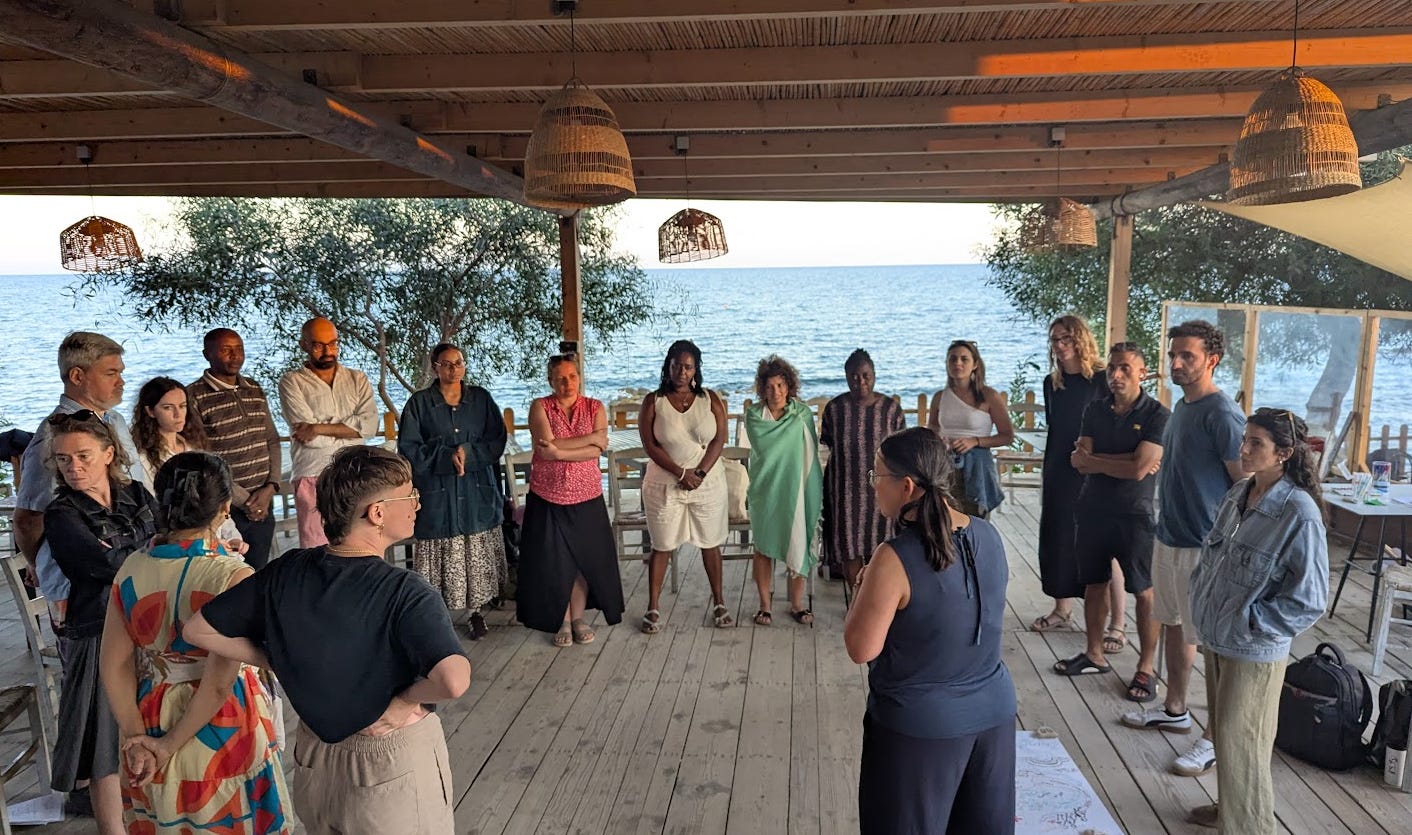
I just returned from Cyprus, for the inaugural convening of my Building Belonging colleague Christina’s Belonging Beyond Borders network. Such a gorgeous gathering of wonderful humans… I’m continuing to integrate. A glimpse of beauty and potential:
In community,
Brian
For the record, Trump didn't take over the GOP. That was done back in 2009 when the Kochs and their fellow plutocrats spent several millions ensuring the tiny Tea Party movement got tons of free publicity to make them look bigger than they were, and then ran candidates like Trump to take over wherever they could using Tea Party rhetoric. The Kochtopus had been planning for it since the Powell Memo in 1971, and Project 2025 (also incorrectly attributed to Trump) was their user manual for when their 50-year plan was finally in place.